




Before microscopes, the world of cells and microbes was a mystery, invisible to even the sharpest minds. But once scientists learned to bend light and magnify the unseen, biology was transformed forever. In this article, we’ll explore this journey from simple lenses to the cutting-edge technologies that reshaped science, medicine, and our understanding of the living world. Details >
Knowledge Base
Have you ever wondered how superresolution microscopy works? What’s the difference between STED, STORM, and MINFLUX? What is “resolution” and what is a “PSF”? What is so special about the STEDYCON? Read on to find out.
If you have any suggestions, questions or ideas for our knowledge base, we would be very happy to hear from you.
ContactEverything about light microscopes, dyes, and imaging
All
#2photon
#aberrationcorrection
#adaptiveillumination
#adaptiveoptics
#antibody
#arraydetection
#basicprinciples
#biology
#comparison
#confocal
#deformablemirror
#diffractionlimit
#donut
#ExM
#fluorescence
#fourier
#immunofluorescence
#labeling
#laser
#lightmicroscopy
#livingcells
#MATRIX
#MINFLUX
#MIRAVA
#modules
#nanobody
#nanometer
#optics
#PAINT
#PALM
#resolution
#selflabelingproteins
#SIM
#SMLM
#STED
#STEDYCON
#STORM
#superresolution
#TEM
#tracking
#virology
#widefield
What is the resolution of a STED microscope?

STED can far exceed the resolution of a standard confocal microscope, which is limited to about 200 nm by diffraction. A moderate resolution increase is readily achievable with standard protocols. Going all the way requires some effort, but the payoff is remarkable. Are you ready to unlock the nanoworld? Details >
How does STED work?

You have heard of STED but don’t have a clear idea how it overcomes the diffraction-limited resolution of confocal microscopes? You maybe even think it to be somewhat complicated? In fact, it isn’t. It’s just physics, smartly applied. Details >
Which microscope has the best resolution?

The elctron microscope achieves the highest magnification and resolution. But does "highest" always equal "best"? Well, that depends on what you want to do with the resolution. Details >
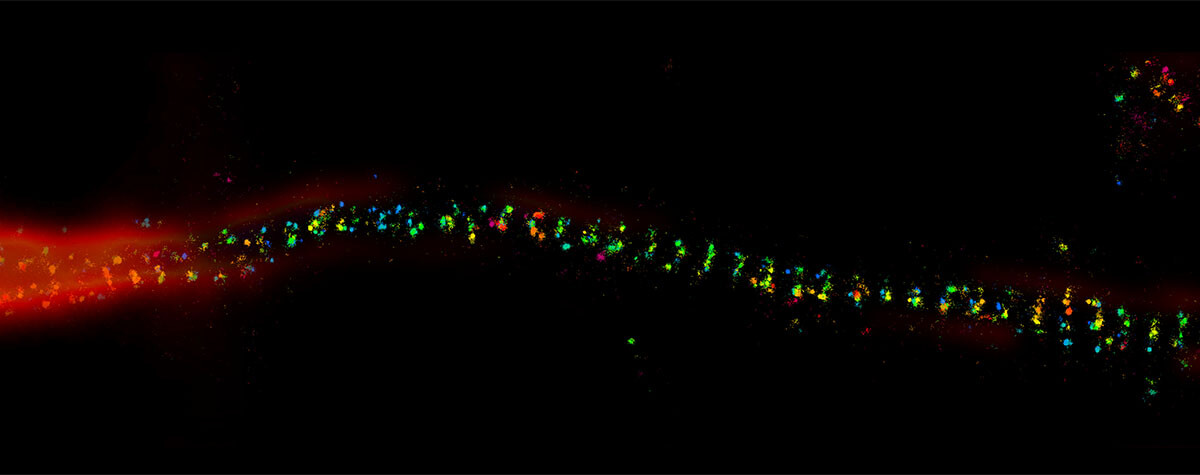
MINFLUX reaches unprecedented spatio-temporal resolution in light microscopy and provides 2D and 3D localization precisions in the single-digit nanometer range. Details >