


Breaking the multi-laser barrier in multi-color superresolution imaging
Highlights
- Superresolution imaging with more than two colors has long been limited by the need for multiple depletion lasers, complex alignments, and lengthy post-processing
- By combining a single 775 nm STED beam with an expanded excitation range including 685 nm, abberior’s MIRAVA POLYSCOPE facilitates imaging of up to four colors in STED resolution in a single acquisition step
- Multi-color STED on the MIRAVA POLYSCOPE provides highest performance, unmatched ease of use, and outstanding image quality across the visible spectrum
Multi-color superresolution imaging with a single STED laser

Introduction
Multi-color stimulated emission depletion (STED) microscopy is often considered tedious and technically challenging. It traditionally required multiple STED lasers, careful alignment, and compromises between resolution, signal crosstalk, and sample health.
abberior’s MIRAVA POLYSCOPE offers a previously unavailable level of optical integration and spectral flexibility for confocal and superresolution microscopy. It facilitates multi-color superresolution imaging with up to four fluorophores using only a single STED laser for depletion, without the need for further data processing and alignment of STED beams with different wavelengths.
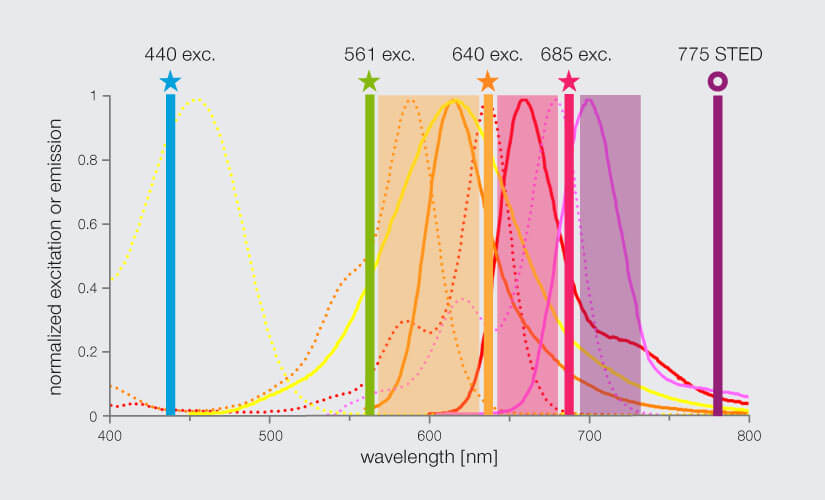
Figure 1: Absorption (dashed lines) and fluorescence (solid lines) spectra for abberior STAR 460L (yellow), STAR ORANGE (orange), STAR RED (red), and STAR deepRED (purple). Suitable excitation lines (440 nm, 561 nm, 640 nm, 685 nm) and detection windows (orange for STAR 460L and STAR ORANGE, pink for STAR RED, purple for STAR deepRED) for these dyes on the abberior MIRAVA POLYSCOPE are highlighted. The 775 nm STED laser is perfectly suited to de-excite all four dyes.
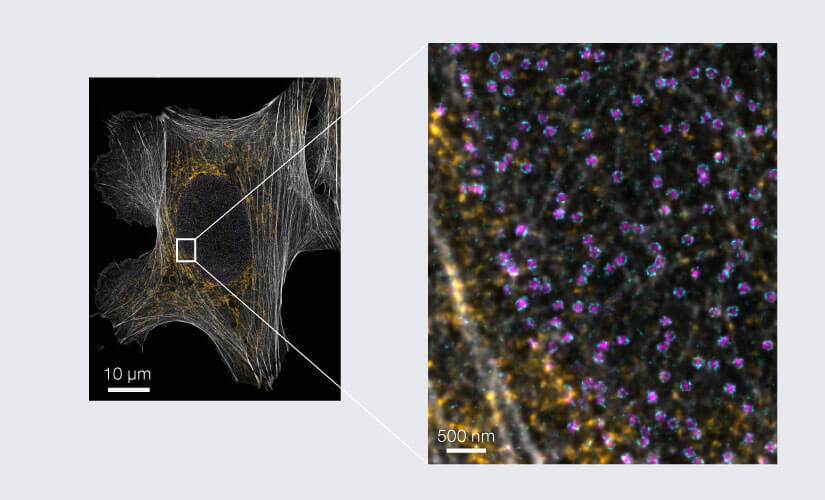
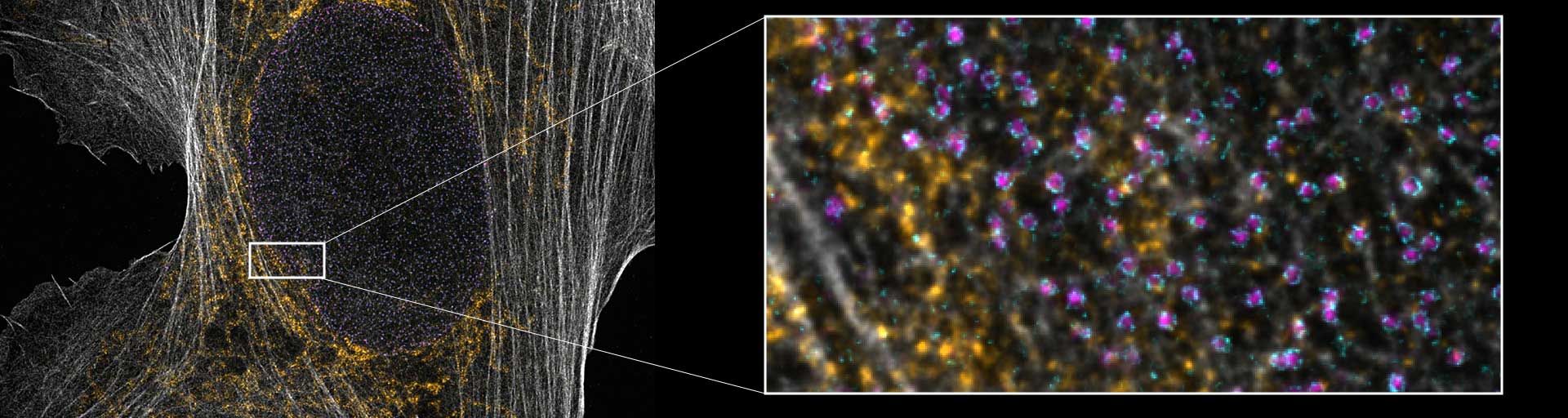
Figure 2: 4-color STED image using a single 775 nm laser. Mitochondria were labeled with Tom20 and STAR deepRED (orange), ELYS in nuclear pores with STAR RED (cyan), multiple nuclear pore complex proteins with Mab414 and STAR 460L (magenta), and actin was labeled with phalloidin-STAR ORANGE (gray).
De-exciting with the 775 nm STED laser
The pulsed 775 nm STED laser is supremely suited to de-excite fluorophores emitting in the orange to deep red spectrum. It provides high resolution at low STED power, which reduces bleaching of fluorophores. Using only a single STED laser instead of two (or even more) to deplete a number of fluorophores at the same time has multiple advantages:
- One-step acquisition of up to four STED channels, speeding up image acquisition
- No advanced alignment, no image shifts, no drift
- No need for post-processing to combine individual images
- Repeatable acquisitions possible without channel crosstalk or bleaching artifacts
Extending the excitation range into the deep red spectrum
The addition of a 685 nm excitation line extends the available excitation range into the deep red spectrum, allowing users to explore this region with dyes such as abberior STAR deepRED. This dye combines spectral separation and photostability. When imaged with STED, it yields high resolution at minimal depletion power, effectively adding a superresolution channel without a noticeable increase in overall sample illumination or bleaching. Importantly, STAR deepRED shows very little re-excitation by the 775 nm STED beam at the required depletion power, making it a perfect addendum to other fluorophores (Fig. 1).
Recommended dye combinations for multi-color STED
For 3-color STED, a combination of the dyes abberior STAR RED, STAR ORANGE, and STAR deepRED has been shown to give very good results. This combination can be expanded to four colors by complementing it with STAR 460L, a long Stokes-shift dye ideal for multicolor imaging that is also efficiently de-excitable by the 775 nm STED laser (Fig.1).
On MIRAVA, thanks to RAINBOW spectral detection each channel is cleanly separated with minimal crosstalk – no unmixing required. Figure 2 shows an example image for the above dye combination, recorded on MIRAVA. All dyes provide very high resolution with hardly any crosstalk when imaged with STED, and the localization of ELYS at the perimeter of the nuclear pore complexes becomes clearly
visible.
MIRAVA modules empower multi-color STED
MIRAVA provides up to seven excitation lasers (405-705 nm) and five RAINBOW detection units (400–780 nm), allowing outstanding flexibility in spectral design. By using an additional 589 nm STED laser, the number of imaged fluorophores may be expanded beyond four. Fluorophores emitting in the same spectral channel can be separated based on their lifetime with TIMEBOW lifetime imaging, providing even more possibilities for multiplexing.
Conclusion
Multi-color superresolution confocal and STED imaging is readily available with abberior’s MIRAVA POLYSCOPE. Its excitation laser lines are matched with high-performing dyes extending into the deep red spectrum. Depletion with a single 775 nm STED laser facilitates robust superresolution STED imaging with up to four colors, providing high resolution at low laser power and perfect channel registration. MIRAVA thus redefines multi-color STED microscopy by delivering top-tier resolution with minimal complexity.
Authors
Gero Schlötel, Isabelle Jansen, Frederik Köpper